Shop tiers, investments & components
Souls you spend in a column don't just buy the item — they fill that column's hidden Investment Bonus track, so a focused build out-stats the same souls spread thin.
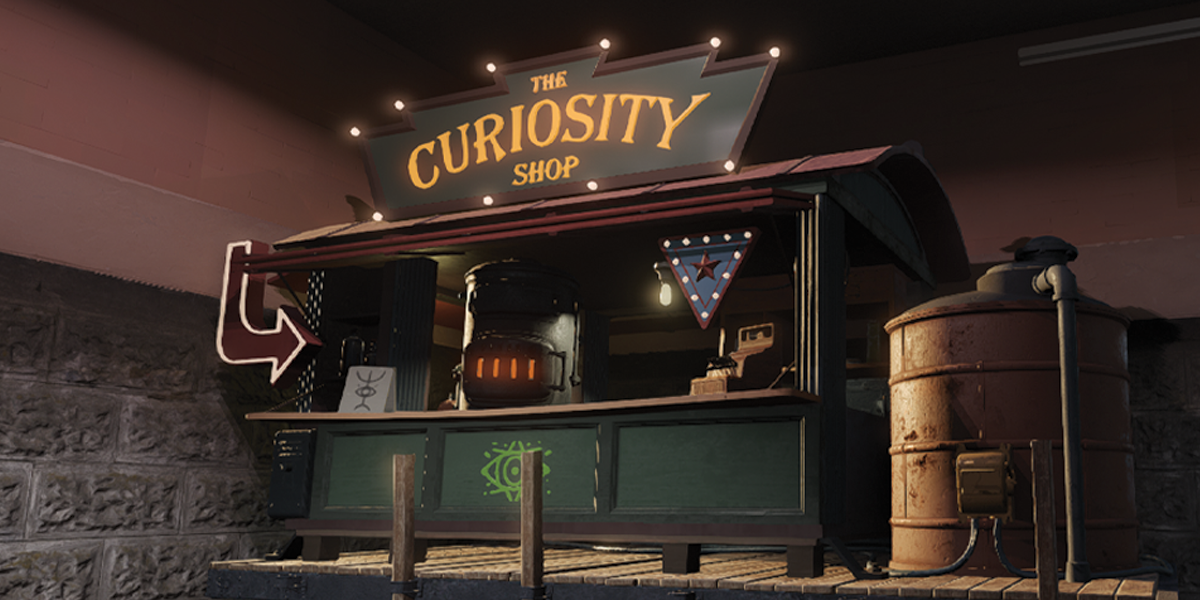
The Curiosity Shop sells items in three columns — Weapon, Vitality, Spirit — across four soul tiers (800 / 1,600 / 3,200 / 6,400). The more souls you sink into one column the bigger its passive Investment Bonus, and pricier items are built up from cheaper ones for just the price difference.
Three columns, four tiers, sixteen slots
Every item sits in one of three columns. Weapon (orange) boosts your gun and melee, Vitality (green) keeps you alive — health, resists, lifesteal — and Spirit (purple) powers your abilities; the colours match the damage types, so a bullet hit flashes orange and a spirit hit flashes purple. Each column is laid out in four soul tiers: Tier 1 costs 800, Tier 2 costs 1,600, Tier 3 costs 3,200 and Tier 4 costs 6,400 — each tier roughly doubles the last, and a Tier 4 is your game-defining item. You have sixteen item slots total: twelve base slots split four-and-four-and-four across the three columns (each base slot is locked to its own column), plus four flex slots that accept an item from any column. You earn the flex slots from objectives rather than buying them — that's its own mechanic. One thing newer players miss: you can sell. If you haven't left the shop's footprint since buying, you get a full 100% refund (and any unsecured souls you spent come back as secured); once you've walked away, selling later only returns half the souls. So the moment to undo a mistake is before you leave the stall.
The Investment Bonus track
This is the system most players never read, and it quietly decides builds. Every soul you spend on items in a column is added to that column's investment total, and as the total crosses thresholds you gain a free passive bonus to that column's signature stat — bonus Weapon Damage for Weapon, bonus Health for Vitality, and flat Spirit Power for Spirit — stacked on top of whatever the items themselves give. The track ramps in small steps as you spend (around the 800 / 1,600 / 2,400 / 3,200 marks) and then takes a big jump at 4,800 souls spent in a column — that 4,800 breakpoint is the one good players deliberately aim for — with further spikes deeper in. The shop shows it as a bar that fills under each column. Valve has retuned the exact percentages and added breakpoints across the 04-30-2026 and 05-22-2026 patches, so the precise numbers drift patch to patch, but the rule is stable: concentrating souls in one or two columns is worth more than smearing them across all three. That's why a clean Weapon or Spirit build hits harder than a do-everything build of the same net worth — the focused player is collecting an Investment Bonus the generalist isn't.
Components and the pay-the-difference rule
Bigger items are built out of cheaper ones. When an item lists a component you already own, buying the upgrade charges only the difference, not the full sticker — own the 800 component and the 1,600 upgrade above it effectively costs you the remaining 800. The component is consumed and folded into the new item: its stats carry over, and the upgrade takes the same single slot, so building up is the cheapest way to grow power without running out of room. Most components branch — one cheap component can build into several different higher-tier items — so buying it early gives you a usable item now AND pre-pays part of whichever endgame item you commit to later. Picking an upgrade consumes the component down that one branch, so when the build forks, take the branch the match is actually asking for rather than autopiloting a recipe.
How to play it
Spend on your spikes — souls in the bank do nothing, and because tiers roughly double, the next item you can afford is a real power jump, not a small one. Commit to one or two columns so you actually ride the Investment Bonus instead of scattering souls across all three; a 'main' column plus a support column beats three half-built columns of equal cost. Rush a cheap component on your spike column in lane — it's a working item immediately and a down-payment on its Tier 3/4 later. Watch the column bars: if you're a few hundred souls short of that 4,800 jump, the next item in that column is worth more than its price tag, so buy it before you branch out. Abuse the refund window — before you step off the shop pad you can buy-and-revert to test a stat or to temporarily free a slot at zero cost, but once you've left you only claw back half, so don't impulse-buy on your way into a fight. When slots get tight, upgrade rather than add: fold a component into its bigger version to keep both the stats and the slot. And don't auto-dump 6,400 on a Tier 4 the second you can afford it if a 1,600 component first tips your column over a breakpoint or finishes a path — sequence your purchases to land power right before the fight, not after it.
Raw dataidentity & API
identity
- id
- mechanic_shop_tiers_and_investments
- slug
- shop-tiers-and-investments
- category
- items
- flowStage
- shopping
- aliases
- shop, curiosity shop, item tiers, investment bonus, weapon vitality spirit, tier 1 2 3 4, 800 1600 3200 6400, item columns, components, build path, builds into, upgrade path, recipe, pay the difference, sell item, refund, 16 slots
- sourcePath
- manual:mechanics/shop-tiers-and-investments
- updatedAt
- 2026-06-06T00:00:00.000Z